In this issue
Music has a beat to "keep time" and we use a variety of time keepers: Your Child is a Time Traveler
|
| |
The Structured Mind, a message from Mr Mark
Last night, I was idly engaged in a logic puzzle on the internet for a few minutes. But the solution to the puzzle soon faded as an engagement as I started to wonder: “How am I arriving at a solution? How do I know I should make the choices I do?” I became fascinated by the fact that I didn’t have to think every logical conclusion through—a lot of the conclusions I needed to solve the puzzle were just there, in my brain, ready to use. Why are they there, in my brain? Because, over the years of my life—and especially the years of my childhood—my brain has wired up all these logical connections (millions and millions of them) that can make (simple) logic puzzles, well, child’s play.
Your young child is wiring up logical connections in her brain as we speak. (So that she can glibly solve logic puzzles in idle moments between assignments as an adult, hehe!) How does a young child install that wiring? Through structured activities. A family meal is a structured activity. Bath-time is a structured activity. Singing a song together is a structured activity. Your child’s brain craves structured activities so that it can use them to make sense of what is going on out there in the world and build those connections that turn sophisticated logic into child’s play.
Summer is upon us, and while for most, summer is a time for escape from the routine, I remind you that for a young child, routine is structure. And for a young child, structure is good. It’s predictable, which makes it comfortable, and makes it useful for a developing brain. As you escape your routine this summer, keep in mind that a young mind loves routine. But that’s okay, even as Mom and Dad are bent on escaping it. Just sing a song to (with) your child. A familiar song (every song we’ve sung together for the past ten weeks) is a mini routine that will engage your child’s mind and help to build those connections that will be with your child for the rest of his life.
(signed) MR MARK
Spring Classes are done!
P.S. The spring session of Music Together is done (except Sunday, which runs one more week). I’ve loved every minute of it, and I hope you have too. Your child did. (Really, I did love it. I kind of zone out once class starts and just have fun with you and all my families. I relax, knowing after years of experience, that it’s doing wonders for your child’s development.) I’ve said it before, I’ll say it again: Thank you so much for being a Music Together family. Back to Top
|
| |
Your child is a time traveler.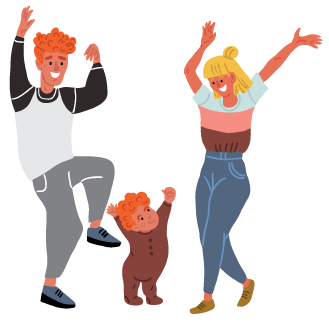
Traveling through the different ways to "keep time" with music
In every Music Together® song collection there is a variety of groupings of musical beats in the songs (technically, the time signature of a song). For example, in the current (er, just finished) Maracas collection,“Dancing with Teddy” has a 1-2-3 1-2-3 beat (waltz-time, it’s often called); "Su La Li has a gentle" 1-2-3-4 1-2-3-4 pulse, contrasting with "All Around the Kitchen's" boisterous four-on-the-floor; William Tell’s Ride bounces back and forth smartly—1-2, 1-2, 1-2; and Tsakonikos differentiates itself with an enchanting and unusual 1-2-3-4-5 1-2-3-4-5.
Music has a pulse, a regular beat, a way to propel itself through time that is generally regular and reassuringly predictable. We want our children to discover the “beat” of music (as well as the tonality or pitch and many other aspects of music). The regularity of the beats in our songs help children readily become familiar with them—the human brain adores recognizing patterns—and the variety of the beat groupings in our songs (as in all music) give personality to, and spark interest in, each song—the human brain thrives on discovering new patterns to add to its inner collection.
For infants, the fascination of watching mom and dad (that would be you, dear reader!) wave their arms and clap their hands to the beat of a song is stimulation enough. Toddlers—who spent their infanthood watching mom and dad—will start to wave their limbs and clap their hands to join in the big game. By preschool age, not only are they grasping the idea that the waving/clapping/jumping rate can be moderated by the songs they are singing or the music that they are listening to, but they are getting adept at language as well, and are starting to substitute words with matching rhythms into their singing and chanting. (A simple understanding how rhyming words work in language development is analogous to the understanding that a song has a pulse that can be emulated in music development.) Vocalization—while speaking language—has an implicit ordering of sounds through time to make them intelligible. (Our brains form sentences faster than our mouths can say them—each child figures that out and joins thoughts with communicating accordingly.) Music describes a different way of feeling and hearing time pass, with its predictable and reassuring and pleasing beat/pulse structure.
By the time your child is ready for “formal” schooling, “time travel” experiences through speech and through music are intertwining in their brains and—along with the kinesthetic movement of a body and its limbs through time and space—each skillset domain (speech, music, coordinated movement) informs and enhances the others.
Happy travels to your child! Back to Top
|
| |
NOW can you hear the Maracas?
In the last newsletter, I had a challenge for you, dear reader. Which songs in the Maracas collection actually feature a Maraca or two playing? I hear two songs with Maracas. The first, haha, is "Hello Everybody" so, yes there is a Maraca playing at the first note of every Music Together collection. The second song is right after that, "Hop Old Squirrel". Do squirrels shake acorns as their own version of Maracas? Probably. Do squirrels shake everything they can grab and think they are maracas? Possibly.
Note, some other songs in the collection use shakers (like our red egg shakers in class), but shakers sound "tiny-er" compared to their big cousins the maracas. Back to Top
|
| |
Music has a beat, and your time-traveling infant can sense that beat
Speaking of young time-travelers, young child research indicates that babies only months old respond to the patterns we call musical rhythm.
For instance, a recent study published in the journal Developmental Science (March 2026) concludes that:
- Infants as young as three months are responding to rhythm patterning heard in music (maybe even younger, but the study didn't work with newborns).
- All infants regardless of age responded, there doesn't appear to be a maturing as infants age--three month olds, six month olds, they're all ready to dive in.
- Parent rhythmic ability is not a predictor of child rhythmic ability, as in, it doesn't matter if you think you are "musical" or not, your child wants to be engage with the patterns of music anyway..
- Parents interacting with the music along with their infant children was a positive factor in the skill development. Hmmm, parents and children engaging in musical activities together. Where do we see that happening weekly for 45 minute sessions?
Our music classes together are the best place for all youngsters to experience and internalize those rhythms, as they begin to make music a life-long part of their personality. Back to Top
|
| |
Summer Session 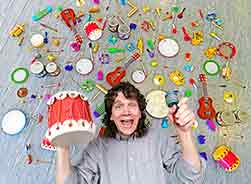
Mr Mark's Summer Session--featuring his own personal song collection just for his families (of which you are one)--is approaching--mid June through July. (It's not a Music Together collection, but just as fun, just as musical!) Classes inside in Lake Bluff and outside at Old School Forest Preserve (which is kind of in Libertyville) REGISTER HERE!
(The Fall Session starts mid-September).Back to Top
|
| |
Dancing all around the kitchen with Mr. Mark!
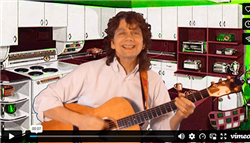
Here's a "cooking" video for you to enjoy at home between classes. No commercials! Mr. Mark singing along with pots and pans about pots and pans. See the video
There are also more Mr. Mark Music videos HERE
Back to Top
|
| |
|