In this issue
|
| |
 Pop Quiz (Multiple choice, I'm making it easy.) Pop Quiz (Multiple choice, I'm making it easy.)
Q. What is your young child's favorite sound in the whole wide world?
Is it:
A) Toy commercials?
B) Bulldozers and Backhoes?
C) The Music Together character Uncle Jerry singing "Don Alfredo Baila" ("R-r-rapido!")
D) Your alarm clock<snooze>going off<snooze>repeatedly<snooze>for an hour<snooze>each morning<stretch>?
E) The voices of primary caregivers, like parents (that would be YOU!), that make a child feel loved and secure and content?
If you guessed E), congratulations! Keep reading below. If you guessed something else, well, please go back to the top of this newsletter and start reading again--Thank you.
Your child dotes on your voice, for all the above reasons (makes her feel content, confident, focused, affection, etc.). When you read picture books to your child, it's your voice that keeps her attention above all else. Even though you are probably not a professional actor hoping to win an Oscar this week. (If you ARE hoping...I hope you win! Um, what was the name of your movie again?...) Just as you don't need to be a voice-over artist to mesmerize your child with a story, so, too, you don't have to be opera-ready to sing a song to your child. Your child LOVES your singing voice, regardless of whatever you think of your singing voice.
By now, you have memorized practically all the song on the STICKS CD. You probably have some of your own versions of some of the songs. ("May, may all, may all children everywhere--GO TO SLEE--EEP!!!")
Why sing? Human interaction is not just key to child development--it is THE KEY to child development. And, as great as the STICKS CD is, YOU interacting with your child is going to trump 44.1kb digitally recorded studio sound every time. Sing along with the CD (Singing "Trot Trot to Grandma's House" on your own in the shower is fine, but singing "Trot, Trot..." in front of your child is more germane to what we're talking about here.) Sing on your own, without the CD (without a net, as we say in the biz)
Here, try this. Every time you get in the car with your youngster, after he's all buckled in and as you are buckling in, sing "Driving in the Car." Your cue will be the buckle: <Click>"Zoom, zoom, driving in the car, here we go, here we go...." One of the cool things about doing this is that you can surreptitiously watch your child in the rear view mirror as you as singing to see how he responds. And just how will he/she respond? I will leave that as an exercise for you, the reader, to definitely try-this-at-home. PS, if your spouse and/or older children are in the car, you ALL have to buckle and sing simultaneously. D'accord!
|
| |
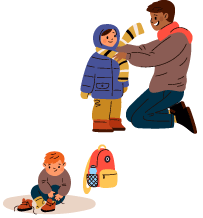 Pro Tip: Keep the music going during your day! Pro Tip: Keep the music going during your day!
Here are some ideas for singing with your child (and spouse and houseguests and pets and etc.) that you can use throughout the day. Substitute your own words to fit the occasion:
To the tune of Mary Wore a Red Dress
When your child is getting dressed in the morning, "Jenny's wearing on blue socks, blue socks, blue socks..." or "Billy's putting on a fun shirt, fun shirt, fun shirt...."
before mealtime,"Time to help mom make lunch, make lunch, make lunch..."
or when bedtime looms, "Time to get pajamas, pajamas, pajamas...."
To the tune of Follow Me Down to Carlow
Getting into the car? Instead of singing "Follow me down to Carlow town," try "Follow me to the grocery store, follow me once you're in your car seat..."
To the tune of When the Saints go Marching in
Having a parade to your next familial activity always makes things more fun, even chores!
"Oh, when the rug, needs vacuuming...." or "Oh, when the tub is full of suds...."
|
| |
 Children and Music and Development and Science Children and Music and Development and Science
There is a connection between the rhythm of music and the rhythm of language. Babies notice it and use it.
A recent child development study has found a connection between how infants process musical rhythm and how they process language. The short take is that young children can latch onto the rhythms of music and use those as building blocks to help their discovery of how language works--which is a good thing!
“Both music and language are built on patterns—beats group together in music the same way syllables group together into words in speech. So if a baby’s brain is good at finding and tracking patterns in sound, that skill can also support early language learning.”
--Jordyn Koveleski Gorman, pediatric speech-language pathologist, child development expert, founder of the online resource hub Eat Play Say.
“Babies are born pattern detectors and [there are] parallels between music and language, both of which contain highly patterned sounds.”
--Rachel Albert, PhD, professor of psychology, director of the LVC Baby Lab.
Also, a real important take-away, in the "all children are musical" department: Genetics does not appear to be a factor a child's acquisition and use of musical concepts. It's not just "musically gifted children", they all do it!
"What did matter was how often parents and babies engaged in music together. Infants whose parents reported frequently engaging in with them showed stronger rhythmic skills, which, in turn, were linked to better ."
You can read a nice summary of the research findings here: https://www.parents.com/musical-rhythm-and-language-for-babies-11893610
|
| |
 DRIP drop DRIP drop DRIP drop DRIP DRIP drop DRIP drop DRIP drop DRIP
OK, so your child will thrive on rhythms (see above research). Here's some rhythmy ideas to help you make sure the beat goes on every day!
The LONG-short LONG-short rhythm of the chant "Water Play" is a rhythm used by other long-standing staples of the nursery rhyme genre. So when you're using Water Play at bath time or meal time or whatever time, you can try keeping the rhythm going but swap out the watery words for something else all together.
HUMPty DUMPty SAT on a WALL
HUMPty DUMPty HAD a great FALL
ALL the king's HORSEs and ALL the king's MEN
COULDn't put HUMPty toGETHer aGAIN!
or
JACK and JILL went UP the HILL to FETCH a PAIL of WA-TER (etc)
This rhythm is also used in one of my favorite poems, "Stopping by the Woods on a Snowy Evening" by Robert Frost.
whose WOODS these ARE i THINK i KNOW
his HOUSE is IN the VILLage THOUGH
he WILL not SEE me STOPping HERE
to WATCH his WOODS fill UP with SNOW. (etc.)
Or "The Tyger" by WIlliam Blake
Tyger, tyger, burning bright
In the Forests of the Night,
What immortal hand or eye
Could frame thy fearful symmetry?
...
Make up your own chants to the same rhythm. Great way to get dressed with your child, for example.
NOW I'm PUTting ON my SOCKS!
TUG tug TUG tug TUG tug TUG
NOW I'm PUTting ON my SHOES!
PUSH push PUSH push PUSH push WHEW!
The technical name for this Long-short-long-short-long-short-long rhythm is Trochaic Tetrameter, but you already knew that, right?
|
| |
 Why so many Songs without Words Why so many Songs without Words
Why do hummingbirds hum?
Because they can't remember the words!
A bunch of the songs in our song collection have no words in any language, including humminbirdese. Have you noticed that? Blow the Wind Southerly, Nigun, Mix it Up!, Spin and Stop, and others. Just simple sounds (la-la-la, da-da-da) and no linguistic meaning whatsoever. Why is that? Lazy lyricists? Wishy-washy wordsmiths?
Our human brains process music information (pitches, rhythmics pulses) separately from language information. Two different routes through our consciousness. Same with your young child, who will process a song like Riding in the Car, which has a strong language component (and some strong language--Watch out! Watch out!), very differently from, say, Mix it Up! with no sung words.
Language processing practice is, of course, a super-great activity for children. Your child gets plenty of that, simply by being a junior member of a very verbal society. We additionally want to make sure they get some purely music processing practice as well, so their developing minds can focus on those pitches and rhythm pulses. That's where the songs with NO words come in. No language to process, just basic music elements.
That said, there's no rule that you can't switch it up with your child. Swap the lyrics out of your favorite songs (Ridin' in the Car, say, sung as "doo, doo, do-duh-do-duh doo..." to encourage a focus on the music components of those songs. Extra credit: YOUR brain, dear reader, will process the song sung sans lyrics differently as well!
|
| |
 Spring Session Spring Session
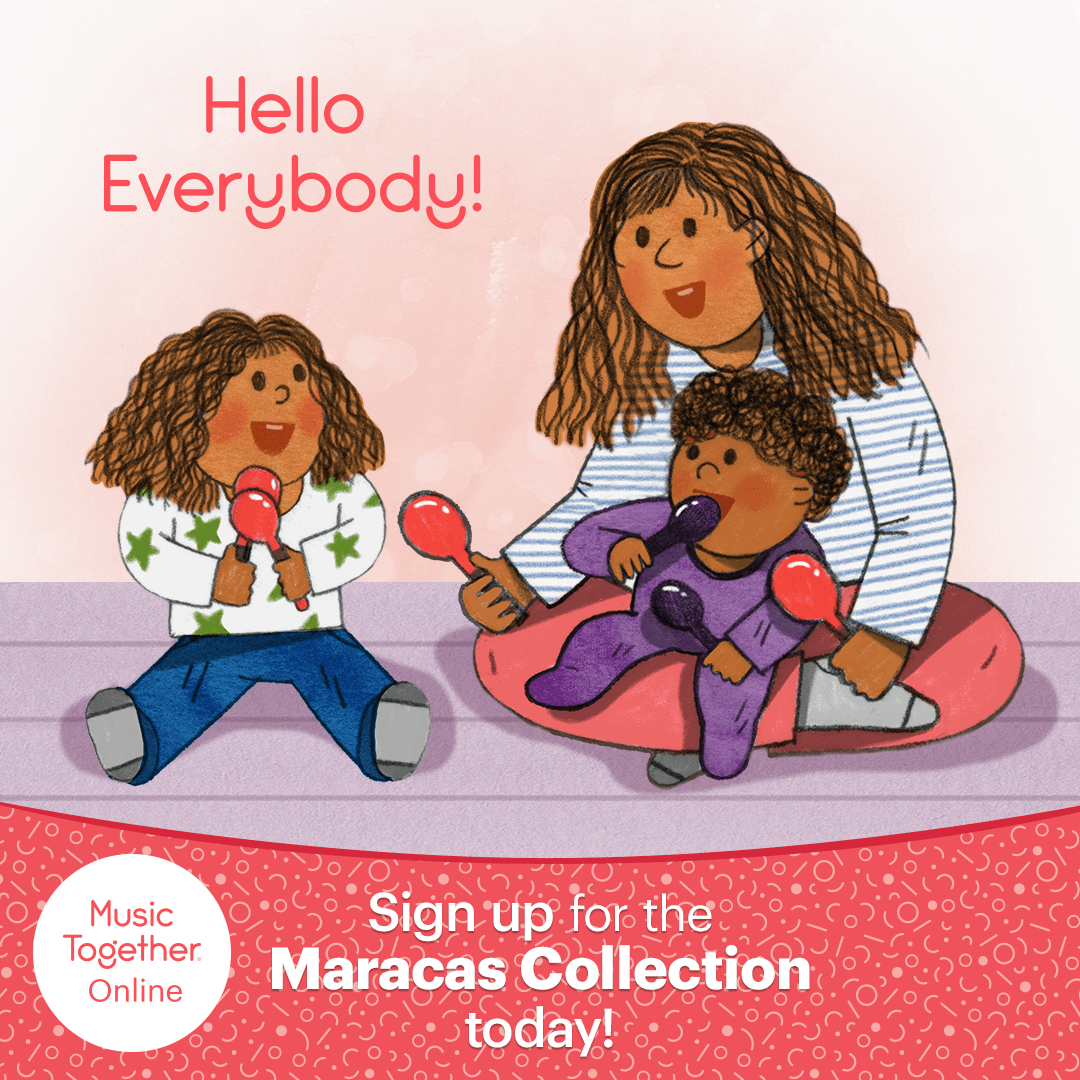
The SPRING Music Together session is approaching--first week of April. (Let's hope SPRING is approaching PERIOD!) New collection of songs and silliness--MARACAS! Why don't you just sign up to attend with your child now, while it's still cold outside? REGISTER HERE!
|
| |
 Trot to Grandma's with Mr. Mark! Trot to Grandma's with Mr. Mark!
Here's a great video for you to enjoy at home between classes. Who's underneath that bonnet?! Join Mr. Mark as he tries several time to get a child some fresh fruit. See the video
There are also more Mr. Mark Music videos HERE
|
| |
 Music Together Resources Online Music Together Resources Online
Make sure you avail yourself of the FREE extra resources available to families on the Music Together Corporate Website. The web link for these wonderous resources is: http://musictogether.com/forenrolledfamilies
|
